I crawled my way back from a years-long crisis. Now I know the truth: real growth can still be born in disorder.
How I Crushed My Writing Goals Since My Last Hospitalization
A heartfelt tale of learned experience.

Summer 2025, Downtown Silver Spring, Maryland. I was on my way to sleep for the night. But I wasn’t quite ready for bed just yet.
Across from the Potbelly’s in Ellsworth Place, in the middle of the mall, I hurried through the crowd as the streetlights flickered on.
I was hot in my black T-shirt and blue jeans. But I was awake. Energized. Pumped up for a fight. Success, my only escape, was too far away. I had every reason to stack up on the bench. Right across the street from the Cold Stone Creamery.
Moving carefully, head down—visually impaired without glasses—I sifted through shoppers, clinging to the right side, heading south towards the theaters. At times, I lifted my head to see shadows mixed with colors. Eyes looked crazy. I could tell people didn’t know how to react.
I stopped at the intersection at Fenton Street, then glanced over at the big clock at the top of the mall entrance. As I squinted hard, I could barely see the hour hand. It was closer to nine. The sun was setting fast. But the streetlights were on. And I was getting closer to stability.
I walked as far away from the ice skating rink as I could, then sat down on the bench towards the end of the street. I downed the last of my coffee, then removed my five-subject notebook from my backpack, feeling determined as I found a pen buried in my pockets.
Buzzing with energy, I jotted down my plans. Updates. Building. Positioning. Story ideas. How I’d pitch. Was I ready? I thought about it. How would I use the night to get further?
I kept re-evaluating, caffeine surging through my veins as I filled a few pages then closed my notebook with a satisfied sigh. As usual, every effort to rebuild helped me feel centered. And every effort to refocus helped me think beyond the next few goals.
Looking back, I realize what I’ve accomplished through persistence. I’ve written through some of the most gut-wrenching, painful, freezing, scorching, irritating, maddening moments you could ever imagine—and in places you wouldn’t believe.
Now, I can reflect on what I did to position myself for success. How I achieved my writing goals despite years of illness, suffering, and hardship.
I realize the most important truth: people deserve to know why…

Why on Earth was I able to crush my goals when I was homeless, in crisis, and living without support?
Truthfully, most writers wouldn’t have kept writing. They wouldn’t have set up a business of their own.
In fact, whether they’re freelancers or authors, they get going too fast. Writers rarely take the time to position for success.
Which means they’re not working with an extensive, long-term content calendar. They may have heard they needed a plan, but they don’t understand that static goals simply aren’t effective.
It’s live, revolving calendars which guide readers along a captivating buyer’s journey. These are systems which align with the author’s experience that keep dedicated writer focused on big picture ideas.
Such writing systems also have to keep a writer committed. It turns out that I happen to know about commitment.
Chasing writing goals when you’re stressed, depressed, and you barely want to live—positioning is the key to success
It can be done. You can write through your nightmares. The key is to have about 60-100 goals.
That’s right. I explained it plain and simple. You need 60-100 goals or writing tasks planned.
Most importantly, you don’t let go—not at first. Only once you’ve accomplished so many goals should you consider cutting down on your list, and even then, only in cases of emergencies (life responsibilities, hardship, etc.).
For me, I started by creating a live writing schedule. That’s what I call my revolving set of daily tasks that I’ve scheduled and added to consistently to for years. Daily, often by the hour, I update this comprehensive list of tasks so that I’m confident I’m grounded in the best approach to success.
To me, success is not millions of dollars. It’s achieving a strong, almost unbreakable sense of value and self-worth. Having survived a toll that would have broken any man, I’m more interested in the value I can offer through my writing, whether that means increasing the power of my content, or helping clients afford my services.
Now, how has increasing my value helped me crush my writing goals?
I adjusted my approach to think about positioning, which is how writers avoid years worth of headaches. The key to positioning is to have anywhere from 60 to 100 writing tasks planned, while consistently adding to this list for the purpose of delaying a sense of accomplishment.
Sixty to hundred goals keeps you motivated, while only three to five will stall your momentum. This is why motivational speakers have harped on delaying gratification for centuries. They knew the truth. The sooner your brain thinks its won, the sooner you let up on the pressure.
Now, imagine you’re someone going through a tough time. You’d need relaxation, rest, and recharging, as well as a sustained, consistent effort towards positioning yourself with your writing.
Positioning might mean planning additional content or building a calendar without an end in sight. It might mean taking the notes to build a brand identity or refining your list of services. No matter what, positioning is the key to growth for writers. Without it, writers struggle with finding solid ground.
Remember, you can succeed in writing as long as you’re positioned
The idea is to multiply the goals while delaying the rewards.
To let the sense of accomplishment come naturally by setting many goals. So that despite falling into the gratification trap, you deny yourself instant victory. You remain focused on your pursuit of sixty tasks.
Remember, writers who delay rewards improve. Writers who quickly embrace achievement will see their work suffer.
“Writers who delay rewards improve. Writers who quickly embrace achievement will see their work suffer.”
To clarify, I did things wrong before my last hospitalization—but I fixed the problem quickly
I was hospitalized repeatedly—and wrongfully-through the years of 2022 and 2024. I’ll admit, back then, I did things wrong. I kept a list of a few writing goals and maybe some content ideas to get a little further ahead. But I didn’t have my live, active, years-long, revolving writing schedule to keep me going.
Consequently, I saw myself as achieving victory after publishing each story. It wasn’t long before I was weakened, trapped in my belief that minimal progression was rewarding.
But with each additional writing goal that I evaluated, I realized I’d be more valuable if I delayed a sense of achievement, and instead added to my list of priorities.
Eventually, I had hundreds of goals I needed to accomplish. And the list was growing exponentially by the month.
A glimpse of my live writing schedule—the last 10 goals I listed in my content calendar
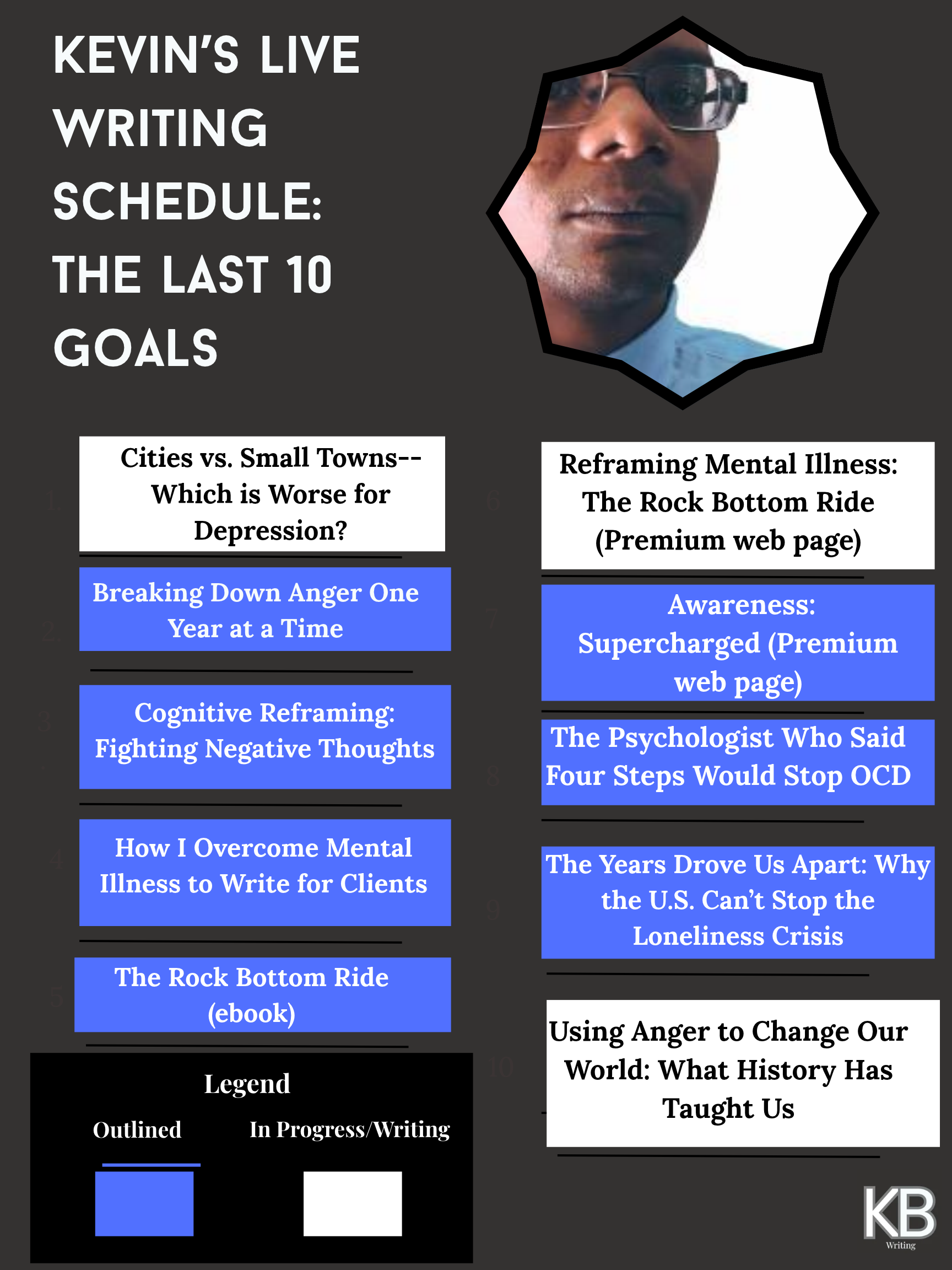
In this graphic, I recorded my last 10 content writing assignments which I intend to write, publish, or pitch or submit for publication.
Now, it’s important to mention: While my writing business is set up as a B2B service, I also write for clients and sell products to clients of mental health organizations. These are also my clients that I’m trying to reach with my writing.
To meet my quota requirement, I knew my best path forward required a system. I’m going to roll out the specifics of that system in the coming weeks. For now, I want to discuss how brainstorming an endless number of content ideas (along with specific business growth-related tasks), will help writers overcome hardship and triple their output.
The power behind my 60-Task Live Writing Schedule
There are two components of my writing system: a productivity system that I designed in a way that increases my output, and a writing system I designed to capitalize on my potential for growth as a writer.
The two components of my writing system aren’t mutually exclusive. They work together, serving a greater function of efficiency and creativity.
Now, understand, the live writing schedule technique isn’t new. Writers have been preaching for decades about systems, particularly, Content Management Systems and the way they work for writers.
But my goal was to create a system that didn’t involve a great deal of technical knowledge, but would nonetheless assist me (and other writers) in tripling output—and dramatically improving in the process.
Here’s how the writing side of my writing system works:
I brainstorm 10 content ideas
I work on the content
I refine the schedule so that I guarantee my content calendar positions my clients (or other businesses) for long-term success.
I add additional content ideas to my schedule while continuously evaluating the overarching value of the entire schedule
I add even more content ideas that build on the now-planned content (for a minimum of 60 planned stories)
The difference between my approach and others is that it’s designed to fluctuate so that I am consistently closer to being able to “take off” with my writing.
What I mean by this is that I’m in a position to send many dozens of cold pitches at once. I’m in a position to devote considerable time to marketing my writing.
Now, let’s consider other writers. For them, a system will yield similar benefits. A writing system puts writers in front of their writing so that they never feel like they’re wandering in circles.
Of course, to the untrained eye, the opposite may seem to be true. People might think, with all this planning, doesn’t it mean you’re not progressing?
The truth is this: Every expert is secretly on top of their journey. Readers can’t see the systems behind their work. They can only benefit from the growth the writer embraces.
Now, let’s break down the power of the 60-Task Live Writing Schedule. There are three important criteria being met here.
Flexibility
Switching tasks and re-evaluating priorities gives writers the freedom to pursue any writing opportunity at any time, provided they plan for expenses, revisions, editing, etc. Without being restricted by a shorter list of planned tasks, adjusting to stress or challenges becomes easier.
Growth
Adding new goals empowers writers to see how big their brains are getting, so that they begin to see the big picture and the ways they can increase their content’s value. Growth happens as writers learn to identify writing-related weaknesses then gradually learn to improve their content.
Self-discipline
Expanding a list of writing goals stops writers from feeling a sense of achievement too early. Delayed contentment is the key to building the mental toughness required to meet the demands of a writing life. The longer and more incomplete a writer’s schedule, the greater the drive to fulfill reader’s needs.
With my approach, and these values, I gained confidence at a time when writers typically break down, which empowered me to drive emotion into my writing
I completed hundreds of writing assignments for clients at a time where I was unsafe and living in a dangerous housing arrangement. I was able to write effectively because I had a live, revolving, and active working calendar.
Recently, I built the foundation for my writing growth from inside a psychiatric unit. The loss of freedom didn’t cost me flexibility because I had a progressive system that I created. A system for grounding me in the best possible set of writing tasks that would position me and my readers for success.
See the results for yourself—check out some stories I published during a time of hardship
Learn, get inspired, and feel the empathy in my writing.
Having Hope While Facing Hardship

Having hope isn’t easy when you’re experiencing hardship. But learning how to hold on will help you move beyond a day-to-day struggle.
Mindfulness Starts with Loving Your Surroundings. Here’s What to Do if You Can’t

Practicing mindfulness in toxic places requires a careful approach.
How to Escape Social Isolation: The Ultimate Guide to Reconnection

Social isolation is becoming more common. Learn how to build meaningful connections.
Clients, readers, and writers—remember the value behind my system
Writers who write with five goals will see their minds wander. There is never enough to take into account to guarantee a period of attentiveness.
With only a handful of goals, writers at the start of their careers will write without empathy. They haven’t yet established an emotional connection to what they’re writing.
Such a connection only occurs when writers are deeply immersed in their work. Meaning, writers must work within a system of extensively planned goals.
The more complex the thought process, the more meaningful the writing, the more likely a writer will write in a way that positions themselves for success.
For writers, achieving flow state doesn’t equal attentiveness.
Attentiveness equals more goals plus constant repositioning.
Writers who focus on positioning constantly re-evaluate the emotional impact of their writing. They consider the timing of each publication and the manner in which they convey big picture ideas. Live adjustments to a content calendar guarantee an exceptional strategy. Especially when the list of assignments increases.
I focused on positioning and accomplished my goals
I’ve tripled the amount of content I write in a considerably shorter time-frame.
I’ve written stories revealing my experiences with illness and suffering.
I launched a new website that grounds readers in powerful, emotionally resonating, well-researched writing. My website reflects the values that I share with the behavioral health care system.
Most importantly, I’ve designed a system which increases the value I offer to clients. My repositioning, live schedule updates, and overall productivity will help mental health organizations achieve their mission.
In the end, I’m pleased to say their mission is mine. I’d say I’m prepared for the fight of my life.
Ready to request content?
Prepared to discover more writing?