

When I was 14, I was so depressed I couldn’t lift my head. My face was usually bored, and feelings of apathy were common.
While I maintained interest in activities I liked, socialization remained an issue. It became imperative that I discuss my troubled thoughts and feelings.
I knew I had to overcome silence and open up in therapy.
What I Learned—Active vs. passive approaches to therapy
Most people don’t know that therapy works best as a gradual process.
That means steady, consistent improvements—not overnight transformations.
The distinction is important. When you enter therapy expecting every issue to be resolved quickly, you start with unrealistically high expectations—a recipe for disappointment.
A passive approach works best in the early phases of therapy, especially if your condition or issue is severe. Later, when you’ve healed, improved, and applied skills learned from therapy to your life, you’ll find an active approach to your sessions will suit you better.
Active is about action, whether that means changing habits, being vocal, or asking questions and providing feedback.
What is an active approach to therapy?
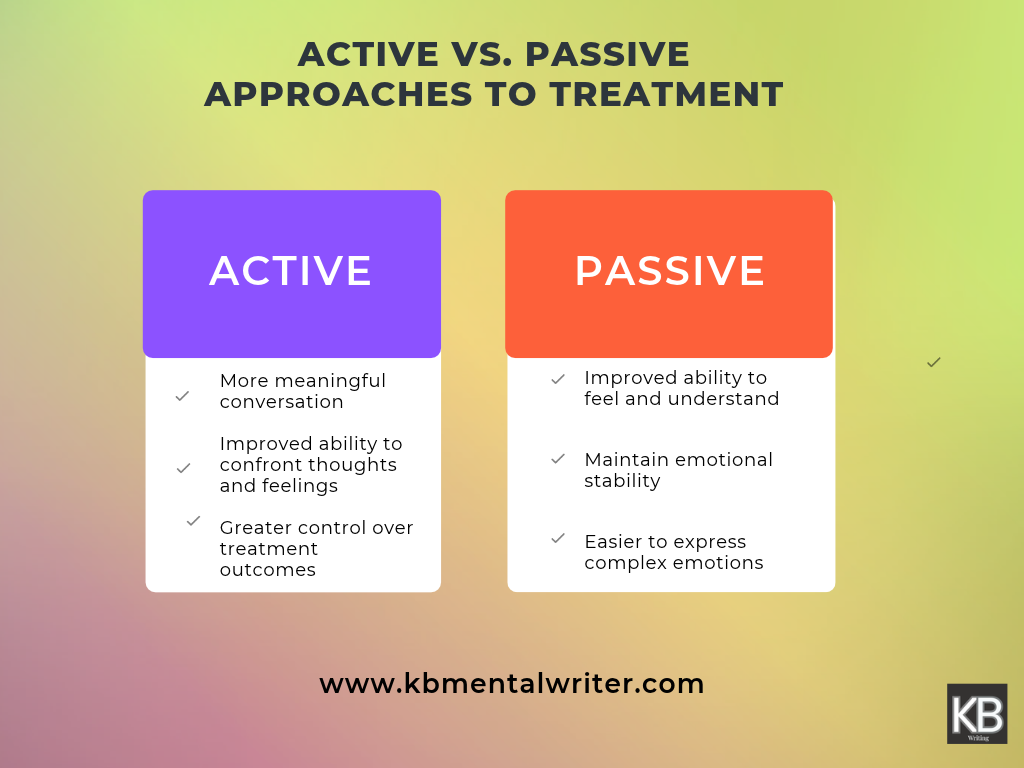
People who think and behave actively prioritize steady progress, consistency, and the power of their voice. They stimulate deeper discussion., prompt more refined questioning, and they get the answers and support they need because they remain engaged, actively inserting their feedback and analysis.
Active means:
Effectively using verbal and non-verbal communication to convey ideas, needs, and emotions
Confronting negative thought patterns and changing thoughts from destructive to productive
Expressing personal beliefs regarding effective treatment approaches
Taking a stand when recovery ideas lack clarity
Allow me to explain.
An active approach to therapy puts you ahead of the conversation—not behind it, where you are a mere observer of your emotions. In active conversations, your opinions, beliefs, and insights matter more.
By choosing to speak up, you validate your views of how therapy should work, which gives you greater control of treatment outcomes.
What is a passive approach to therapy?
A quiet, less energetic response is the more common approach for people who have recently begun therapy.
A passive approach utilizes a sit-back-and-wait style of communication where the individual in therapy responds to questions without extra input.
When you’re passive in therapy, the silence extends longer, you’re less talkative, and less emotionally stimulated.
People who are passive while participating in therapy see the sessions as an opportunity to heal simply by listening, observing, and helping themselves through a gentle, more subtle kind of progress.
Passive means:
Waiting and listening to preserve emotional stability
Taking your time before speaking to guarantee that each experience or challenge is communicated as effectively as possible
Reflecting on your thoughts and emotions instead of actively communicating or inserting constant feedback
Taking time to express emotions sincerely without having to come up with a rapid answer for every scenario.
Let’s look deeper.
A passive approach to therapy isn’t as rewarding. Passive puts you behind the problems where you become a reactor, someone who reacts to what they hear, see, think, etc.
Still, passive approaches are great for preserving emotional stability. They also work well for starting therapy when learning or feeling are the priority.
With passive and active approaches, you get the best of both worlds—the ability to feel along with an opportunity to be an active. The more active you are, the greater the potential to see improvement. But allowing yourself to be passive will increase the transformative power of therapy also.
You get the best of both worlds—the ability to feel along with an opportunity to be an active participant.
You can change your world when you put your brain to good use. Th’s means taking advantage of your willingness to experience things deeply, while also learning how to speak up and make situations better.
What I did to overcome silence
In my early sessions, I didn’t possess self-awareness. I didn’t know what I was missing by remaining passive and not learning to be active.
Later, as my medications kicked in, I found the spark I needed to be energetic and confident in therapy. In doing so, I felt relieved and more productive, as if my sessions mattered. As if my voice made a difference.
It takes combining both active and passive approaches to get the best benefits out of therapy when you have a tendency to be shy and reserved.
Seeing these benefits come to life takes time—yes. But eventually, you’ll begin to see results.
Here’s what I did.
I accepted my silence
For nearly six weeks, I barely uttered a sound, opting instead for guttural grunts, mumbling, and hushed, brief responses. Even as sick as I was, I realized there was a benefit to simply being present. Despite not talking, I could think, reflect, and learn, which is why I accepted my silence early on.
Reflection, I knew, was the best way to start from rock bottom. To me, accepting my silence meant the following:
Not trying to talk too much
Listening more than speaking
Offering answers that communicated how challenging communication truly was.